Attribution Creative Commons Noncommercial No Derivatives Share Alike Zero

Apne Tv Web Series !!hot!! Site

You need a happy ending or fast-paced, song-filled drama. Have you watched Apharan ? Who is your favorite character—Rudra or the cunning Inspector (Mahie Gill)? Let me know in the comments below!

Season 2 picks up years after the events of the first season. Rudra is in hiding, but his past catches up with him via a new, more ruthless adversary. While Season 1 was a tight bottle episode stretched over a few days, Season 2 expands the world. Some critics argue it loses the claustrophobic charm of the original, but the stakes are higher, and Arunoday Singh's performance is even more unhinged. If you loved the first season, Season 2 is a satisfying, if slightly messier, sequel. Rating: 4.5/5 apne tv web series

If you are tired of shows where the hero has a "plastic surgery" twin brother or where the plot relies on coincidences, Apharan is your antidote. It is lean, mean, and merciless. It doesn't treat you like a child; it treats you like a viewer who understands that in real life, heists rarely go according to plan. You need a happy ending or fast-paced, song-filled drama

Streaming on: Voot Select / JioCinema (as of current availability). Let me know in the comments below

In the crowded landscape of Indian web series, where crime dramas often blend into a sea of predictable plotlines and over-the-top action, one show quietly slipped in and reset the bar entirely. 'Apharan' (translating to 'Abduction') is not just another heist story. Streaming on Voot Select , this Arunoday Singh-starrer is a gritty, slow-burn masterpiece that has earned a cult following for all the right reasons.

When Rudra gets pulled into a seemingly simple job—kidnapping a teenage girl from a political stronghold—things go horrifically wrong. What starts as a clean snatch-and-grab spirals into a 48-hour nightmare of double-crosses, political corruption, and visceral violence. Unlike typical thrillers where the hero fires a gun every five minutes, Apharan focuses on the tactical mind of a thief. The tension isn't in the explosions; it’s in the silence, the waiting, and the moral decay of the protagonist. 1. The Anti-Hero You Can’t Hate Arunoday Singh delivers a career-defining performance. Rudra is not charming like a Hollywood anti-hero; he is tired, irritable, and occasionally cruel. Yet, you root for him because Singh plays the desperation perfectly. You see the toll of a life of crime on his face—the sleepless nights, the paranoia, the regret. He isn't a superhero with a gun; he is a man who knows his luck is running out. 2. Grounded Realism No flashy edits. No slow-motion walking shots. Apharan feels like you are watching a documentary about a crime gone wrong. The locations are raw (Uttarakhand’s underbelly), the dialogue is sharp, and the violence is brutal but fleeting. The show respects the intelligence of its audience; it doesn't explain every twist, leaving you to connect the dots. 3. Tight, Suffocating Pacing Created by Jai Mehta and written by Vaibhav Vishal , the series is a masterclass in tension. The "real-time" feel of the kidnapping means you experience every second of anxiety with Rudra. Just when you think he has a way out, the script pulls the rug from under him—and you. 4. No Item Numbers, No Romance Thankfully, Apharan refuses to follow the Bollywood template. There is no forced love track, no dance number in a foreign locale. It is a focused, masculine thriller that stays on track. The female characters (played by Nidhi Singh and Mahie Gill) are not damsels; they are complicated players in the game, often more dangerous than the men. Season 2: Does It Hold Up? Spoiler alert: Yes, mostly.
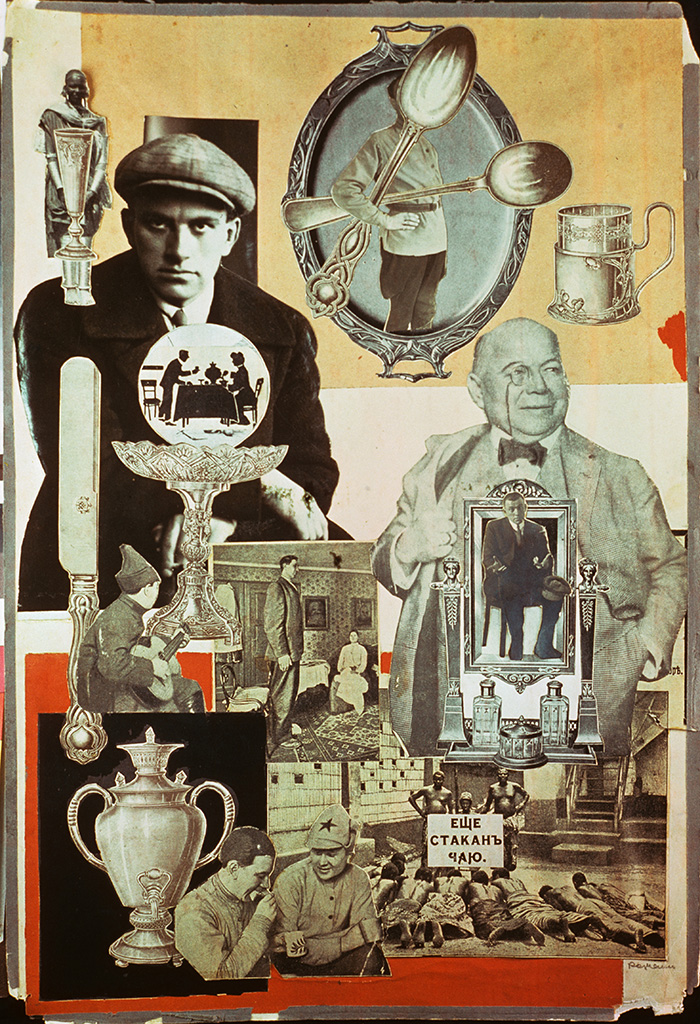
Fig. 1. — Brigade KGK (Viktor Koretsky [1909–98], Vera Gitsevich [1897–1976], and Boris Knoblok [1903–84]). “We had to overcome among the people in charge of trade the unhealthy habit of distributing goods mechanically; we had to put a stop to their indifference to the demand for a greater range of goods and to the requirements of the consumers.” From the 16th to the 17th Congress of the All-Union Communist Party (Bolsheviks), 1934, no. 57, gelatin silver print, 22.7 × 17 cm. Los Angeles, Getty Research Institute, 2014.R.25.
Fig. 2. — Brigade KGK (Viktor Koretsky [1909–98], Vera Gitsevich [1897–1976], and Boris Knoblok [1903–84]). “There is still among a section of Communists a supercilious, disdainful attitude toward trade in general, and toward Soviet trade in particular. These Communists, so-called, look upon Soviet trade as a matter of secondary importance, not worth bothering about.” From the 16th to the 17th Congress of the All-Union Communist Party (Bolsheviks), 1934, no. 56, gelatin silver print, 22.7 × 17 cm. Los Angeles, Getty Research Institute, 2014.R.25.
Collage of photographs showing Vladimir Mayakovsky surrounded by a silver samovar, cutlery, and trays; two soldiers enjoying tea; a giant man in a bourgeois parlor; and nine African men lying prostrate before three others who hold a sign that reads, in Cyrillic letters, “Another cup of tea.”
Fig. 3. — Aleksandr Rodchenko (Russian, 1890–1956). Draft illustration for Vladimir Mayakovsky’s poem “Pro eto,” accompanied by the lines “And the century stands / Unwhipped / the mare of byt won’t budge,” 1923, cut-and-pasted printed papers and gelatin silver photographs, 42.5 × 32.5 cm. Moscow, State Mayakovsky Museum. Art © 2024 Estate of Alexander Rodchenko / UPRAVIS, Moscow / ARS, NY. Photo: Art Resource.
Fig. 4. — Boris Klinch (Russian, 1892–1946). “Krovovaia sobaka,” Noske (“The bloody dog,” Noske), photomontage, 1932. From Proletarskoe foto, no. 11 (1932): 29. Los Angeles, Getty Research Institute, 85-S956.
Fig. 5. — Brigade KGK (Viktor Koretsky [1909–98], Vera Gitsevich [1897–1976], and Boris Knoblok [1903–84]). “We have smashed the enemies of the Party, the opportunists of all shades, the nationalist deviators of all kinds. But remnants of their ideology still live in the minds of individual members of the Party, and not infrequently they find expression.” From the 16th to the 17th Congress of the All-Union Communist Party (Bolsheviks), 1934, no. 62, gelatin silver print, 22.7 × 17 cm. Los Angeles, Getty Research Institute, 2014.R.25.
Fig. 6. — Brigade KGK (Viktor Koretsky [1909–98], Vera Gitsevich [1897–1976], and Boris Knoblok [1903–84]). “There are two other types of executive who retard our work, hinder our work, and hold up our advance. . . . People who have become bigwigs, who consider that Party decisions and Soviet laws are not written for them, but for fools. . . . And . . . honest windbags (laughter), people who are honest and loyal to Soviet power, but who are incapable of leadership, incapable of organizing anything.” From the 16th to the 17th Congress of the All-Union Communist Party (Bolsheviks), 1934, no. 70, gelatin silver print, 22.7 × 17 cm. Los Angeles, Getty Research Institute, 2014.R.25.
Fig. 7. — Artist unknown. “The Social Democrat Grzesinski,” from Proletarskoe foto, no. 3 (1932): 7. Los Angeles, Getty Research Institute, 85-S956.
Fig. 8A. — Pavel Petrov-Bytov (Russian, 1895–1960), director. Screen capture from the film Cain and Artem, 1929. Image courtesy University of California, Berkeley, Berkeley Art Museum and Pacific Film Archive Library.
Fig. 8B. — Pavel Petrov-Bytov (Russian, 1895–1960), director. Screen capture from the film Cain and Artem, 1929. Image courtesy University of California, Berkeley, Berkeley Art Museum and Pacific Film Archive Library.
Fig. 8C. — Pavel Petrov-Bytov (Russian, 1895–1960), director. Screen capture from the film Cain and Artem, 1929. Image courtesy University of California, Berkeley, Berkeley Art Museum and Pacific Film Archive Library.
Fig. 9. — Herbert George Ponting (English, 1870–1935). Camera Caricature, ca. 1927, gelatin silver prints mounted on card, 49.5 × 35.6 cm (grid). London, Victoria and Albert Museum, RPS.3336–2018. Image © Royal Photographic Society Collection / Victoria and Albert Museum, London.
Fig. 10. — Aleksandr Zhitomirsky (Russian, 1907–93). “There are lucky devils and unlucky ones,” cover of Front-Illustrierte, no. 10, April 1943. Prague, Ne Boltai! Collection. Art © Vladimir Zhitomirsky.
of