3D-QSAR
Simplify Drug Design

indian saree xxx

Indian Saree Xxx Now

However, the 1970s introduced a tectonic shift: the . With the arrival of actors like Helen and Zeenat Aman, the saree became a vessel for sensuality. The transparent rain-soaked chiffon saree, clinging to the body, became a revolutionary visual. Songs like Piya Tu Ab To Aaja (1971) didn't just entertain; they challenged censorship boards and redefined the male gaze. This era birthed the concept of "saree entertainment" as a visual spectacle—where the drape, the fall, and the fabric (nylon, chiffon, georgette) became as important as the melody. Part II: The NRI Narrative – The Saree as Cultural Anchor (1990s–2000s) As India’s economy liberalized and the diaspora grew, popular media faced a crisis of identity. The Non-Resident Indian (NRI) genre, led by films like Dilwale Dulhania Le Jayenge (1995) and Kuch Kuch Hota Hai (1998), weaponized the saree as a symbol of "Indianness."

As long as there is a camera and a story, the saree will remain the most versatile costume in the entertainment wardrobe. Not because it is beautiful, but because, like all great art, it holds a thousand meanings, waiting for the right drape to reveal them. — End of Article — indian saree xxx

In the sprawling, glittering landscape of South Asian popular media, few objects carry as much symbolic weight as the saree. It is not merely a garment; it is a language. Over the past seven decades, the saree has transitioned from traditional attire to a dynamic tool of storytelling within the "saree entertainment" genre—a niche yet omnipresent force in films, streaming series, music videos, and social media reels. From the wet saree of 1970s Bollywood to the power-drape of a contemporary OTT female lead, the saree has become a character in its own right, shaping plotlines, defining eras, and fueling a billion-dollar visual economy. Part I: The Golden Age – The Saree as Virtue and Vulnerability (1950s–1980s) The earliest days of Indian cinema were draped in morality, and the saree was its uniform. In the black-and-white era, the way a woman wore her saree immediately signaled her archetype. The pallu (the loose end of the saree) was a shield of modesty, often pulled over the head to signify respect or grief. Actresses like Nargis and Madhubala wore their cotton and silk sarees with the pleats sharply pleated, representing discipline and tradition. However, the 1970s introduced a tectonic shift: the

indian saree xxx

However, the 1970s introduced a tectonic shift: the . With the arrival of actors like Helen and Zeenat Aman, the saree became a vessel for sensuality. The transparent rain-soaked chiffon saree, clinging to the body, became a revolutionary visual. Songs like Piya Tu Ab To Aaja (1971) didn't just entertain; they challenged censorship boards and redefined the male gaze. This era birthed the concept of "saree entertainment" as a visual spectacle—where the drape, the fall, and the fabric (nylon, chiffon, georgette) became as important as the melody. Part II: The NRI Narrative – The Saree as Cultural Anchor (1990s–2000s) As India’s economy liberalized and the diaspora grew, popular media faced a crisis of identity. The Non-Resident Indian (NRI) genre, led by films like Dilwale Dulhania Le Jayenge (1995) and Kuch Kuch Hota Hai (1998), weaponized the saree as a symbol of "Indianness."

As long as there is a camera and a story, the saree will remain the most versatile costume in the entertainment wardrobe. Not because it is beautiful, but because, like all great art, it holds a thousand meanings, waiting for the right drape to reveal them. — End of Article —

In the sprawling, glittering landscape of South Asian popular media, few objects carry as much symbolic weight as the saree. It is not merely a garment; it is a language. Over the past seven decades, the saree has transitioned from traditional attire to a dynamic tool of storytelling within the "saree entertainment" genre—a niche yet omnipresent force in films, streaming series, music videos, and social media reels. From the wet saree of 1970s Bollywood to the power-drape of a contemporary OTT female lead, the saree has become a character in its own right, shaping plotlines, defining eras, and fueling a billion-dollar visual economy. Part I: The Golden Age – The Saree as Virtue and Vulnerability (1950s–1980s) The earliest days of Indian cinema were draped in morality, and the saree was its uniform. In the black-and-white era, the way a woman wore her saree immediately signaled her archetype. The pallu (the loose end of the saree) was a shield of modesty, often pulled over the head to signify respect or grief. Actresses like Nargis and Madhubala wore their cotton and silk sarees with the pleats sharply pleated, representing discipline and tradition.

welcome to 3D-QSAR.com

Fast Molecule Management

Welcome to the first web application for Pharmaceutical Chemistry. 3D-QSAR.com offers user friendly and advanced tools for developing either ligand-based or structure-based 3D QSAR models and performing common useful operations over dataset of molecules.

Sign Up Know More
welcome to 3D-QSAR.com

Explore New Technologies

Our research team is always exploring new technologies and offering them as new products for you to use. Graph Neural Networks (GCNs) are a promising new frontier for Chemistry models development and we are working right now to make them part of the tools available to you.

Read More

Applications

Click on any button to start using the platform. If you want to know a bit more about the application, visit the link below to see all you will be able to do.

Explore Apps
In silico local QSAR modeling of bioconcentration factor of organophosphate pesticides Purusottam Banjare, Balaji Matore, Jagadish Singh, Partha Pratim Roy In Silico Pharmacology Evaluation of molecular structure based descriptors for the prediction of pEC50(M) for the selective adenosine A2A Receptor Nilima Rani Das, Sneha Prabha Mishra, P. Ganga RajuAchary Journal of Molecular Structure Alkylated monoterpene indole alkaloid derivatives as potent P-glycoprotein inhibitors in resistant cancer cells David S P Cardoso, Annamária Kincses, Márta Nové, Gabriella Spengler, Silva Mulhovo, João Aires-de-Sousa, Daniel J V A Dos Santos, Maria-José U Ferreira European Journal of Medicinal Chemistry Computational Studies of 3D-QSAR on a Highly Active Series of Naturally Occurring Nonnucleoside Inhibitors of HIV-1 RT (NNRTI) Waqar Hussain, Arshia Majeed, Ammara Akhtar and Nouman Rasool Journal of Computational Biophysics and Chemistry

A Valuable Tool

We are at the beginning of our journey but our work is already being recognized. These are the projects that mention 3D-QSAR.com as a valuable resource for their results and have been empowered with our tools. We thank you greatly.

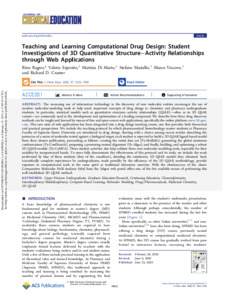
Paper: Teaching and learning computational
                              drug design: Studenti Investigations of 3D
                              Quantitative Structure–Activity Relationship
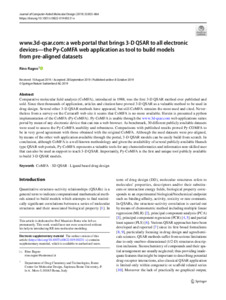
                              through Web Applications. Teaching and Learning Computational Drug Design... Journal of Chemical Education Paper: www.3d-qsar.com a web portal that brings
                              3-D QSAR to all electronic devices. the Py-CoMFA
                              web application as tool to build models from
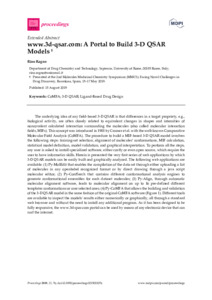
                              pre-aligned datasets. www.3d-qsar.com: a web portal that brings 3-D QSAR to all... Journal of Computer-Aided Molecular Design Paper: a portal to build 3-D QSAR Models. A Portal to Build 3-D QSAR Models. Proceedings

Reference Our Work

3D-QSAR.com is the result of an effort of our research team to offer valuable and easily accessible tools for the development of new active molecules. Cite our work by clicking on the pages or contact us directly.

Contact Us