Reverse Image Search Catfish _hot_ Free -
The premise is simple, yet its implications are profound. A reverse image search allows a user to upload a photo or paste a URL to discover where else that image appears on the internet, who else is using it, and in what context. Instead of trusting a suspicious profile at face value, you can force the image to tell its own history. In the fight against digital deception, this tool acts as a costless, democratic scalpel, cutting through layers of curated lies to reveal the raw truth beneath.
In the vast, interconnected bazaar of the digital age, identity is both a currency and a mask. For every genuine interaction happening on social media, dating apps, or professional networks, there is a potential predator hiding behind a purloined photograph. This phenomenon, known as catfishing, involves luring someone into a relationship or transaction based on a fictional online persona. While the emotional and financial devastation of being catfished is well-documented, the solution is surprisingly accessible, elegant, and entirely free: the reverse image search. reverse image search catfish free
To wield this tool effectively, one must adopt a mindset of healthy skepticism. Do not be flattered by the immediate attention of a stranger who looks like a model. Do not be rushed into a private conversation or financial transaction. Instead, take ten seconds to download the profile picture and drop it into Google Images. Look for duplicate profiles under different names, watermarks that have been cropped out, or timestamps that don't align with the claimed story. The premise is simple, yet its implications are profound
Of course, the system is not perfect. Advanced catfishers may use private photos or original AI-generated images, which will not appear in a search. However, the vast majority of catfishing operations rely on recycled, public images because they are easy to obtain. A clean reverse image search result is not a guarantee of authenticity, but a positive match is an undeniable red flag. It provides a moment of cognitive dissonance—that gut feeling of "this picture has another home"—which is often the only warning a victim needs. In the fight against digital deception, this tool
Furthermore, this tool is not merely for the romantically suspicious; it is a utility for digital hygiene in all spheres. In professional contexts, recruiters can use reverse image searches to verify that a candidate’s LinkedIn photo isn’t a stock image. In journalism, reporters can verify the authenticity of a source photo claiming to be from a specific location or event. Even in real estate, potential renters can check if the "property owner" using a charming family photo is actually using a picture lifted from a real estate agent’s blog. The free nature of these tools (Google Images, TinEye, Yandex, and Bing Visual Search) ensures that verification is not a luxury for the wealthy or tech-savvy, but a right available to anyone with an internet connection.
The primary weapon of a catfish is the stolen visual narrative. They do not create their own fiction; they borrow it from an unsuspecting third party. This could be a minor Instagram influencer, a model on a stock photo site, or simply an attractive stranger whose public photos have been scraped from a social media feed. When you initiate a relationship with a new online contact—especially a romantic prospect—a simple right-click and search can expose the cracks in the facade. If the person claiming to be "Brad, a pilot from Chicago" is actually a model named Marco from Milan whose photos are used across five different dating profiles, the reverse image search will expose the disconnect. It collapses the distance between the avatar and the authentic source.
In conclusion, the reverse image search is the digital equivalent of asking for a second form of ID. It transforms the passive act of viewing a profile into an active act of investigation. In an era where loneliness is commodified and trust is exploited, this free tool stands as a powerful act of self-defense. It empowers the individual to reclaim agency, forcing the anonymous catfish back into the shadows from which they emerged. The next time a suspiciously perfect stranger messages you, remember: the image cannot lie about its origins, but only if you take the free, thirty-second step to ask it where it has been.
The program can do so many things — this list is far from complete
- Do conversions from the 400+ audio related file formats that it can read, into any of the 260+ formats that it can write.
- Read and write the instrument formats of many commercial synthesizers, hardware modules, and software synths —
including formats from AKAI, Ensoniq, Korg, Kurzweil, Roland, Yamaha, Native Instruments, and many more.
High quality conversion can be made between most formats, preserving important synthesis parameters such as envelopes and LFOs.
- Read several disk formats that cannot normally be accessed by Windows, including CDs from AKAI S-1000, AKAI S-3000, E-mu Emulator III, Kurzweil, and Roland S-5xx and S-7xx series.
- Up to 32-bit floating point data precision for mono and stereo data.
- Fully supports SF2 and DLS level 2, as well as a large subset of SFZ v2.
- You can also use it as an editor for many other synths — for some, it is the only PC editor.
- Data is organized in an easy-to-use three pane layout — with a hierarchical instrument tree to the left, a waveform list in the middle, and a property inspector to the right.
- Graphical editors for instrument parameters — e.g. the much-applauded loop editor that lets you easily find the best loops.
- Edit parameters for multiple items simultaneously — as quickly and easily as you edit a single item.
- Audition, i.e. play & listen to, instruments directly using the PC keyboard or an external MIDI keyboard.
- Convert song data between several formats (e.g. MOD-tracker modules into SMF accompanied by custom instruments).
- Render your songs into audio clips with superior audio quality using the bult-in software synthesizer.
- Convert FM-synthesis instruments into sampled instruments — with support for all major Yamaha DX-series SysEx formats.
- The Batch conversion tool makes converting large numbers of audio files extremely simple — including optional effects processing.
- Processing functions help you with tasks such as resampling, fading, merging, splitting, normalizing, or searching and replacing text metadata.
- The Audio recording function not only records audio, it can also automatically sample any MIDI or VSTi 2.x instrument.
Ok, so what doesn't it do?
It can only do very basic low-level MIDI event editing (look elsewhere for a sequencer).
It won't handle more than 2 audio channels (so no surround sound).
It needs to fit all audio data into memory (but RAM is plentiful today).
It can't transcribe audio recordings into MIDI notes (try an AI tool for that).
If you are unsure if it is for you — then why not download the free 30 day trial version? Seeing is believing!
You can try almost all functionality — we don't hide any ugly surprises — we have confidence in our product.
→ Screenshots…
Screenshots
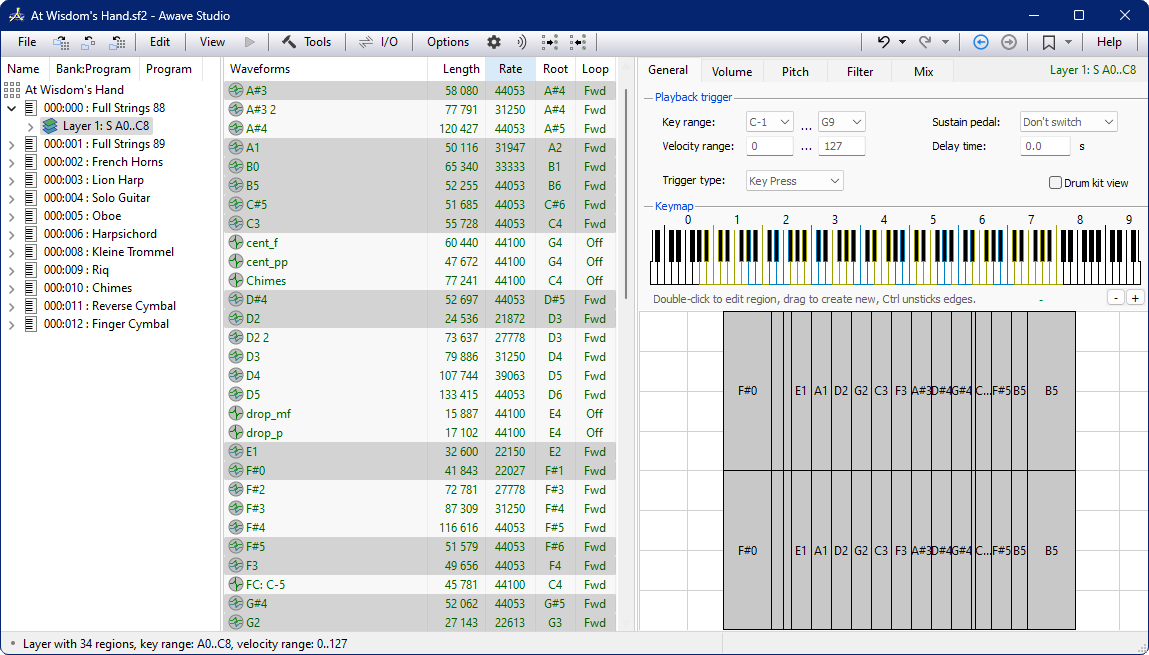
Awave Studio main window + Layer general tab with keymap editor
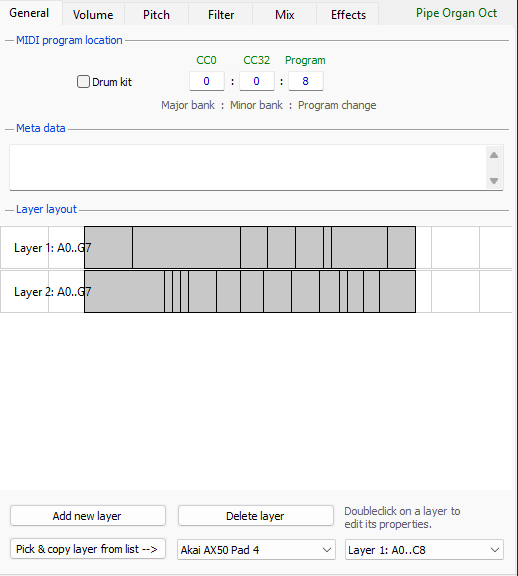
Instrument general tab with layer overview
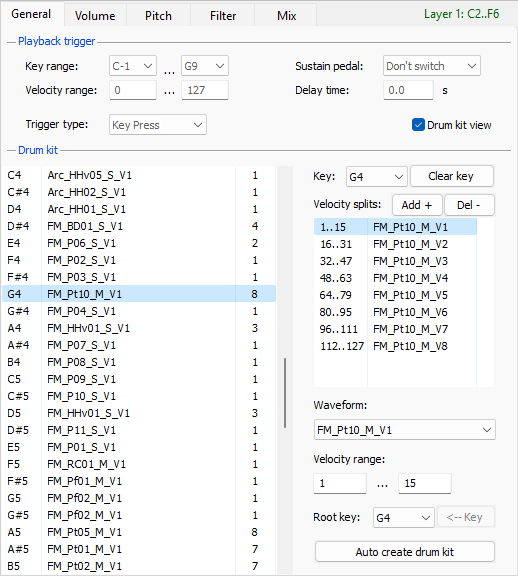
Layer general tab with drum kit editor
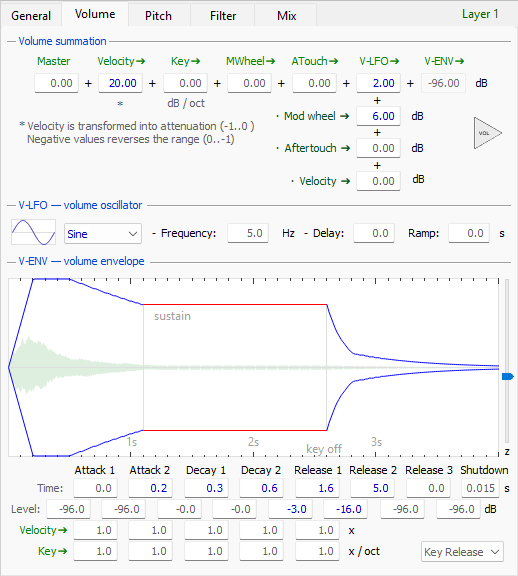
Volume articulation tab, with lfo and envelope editor
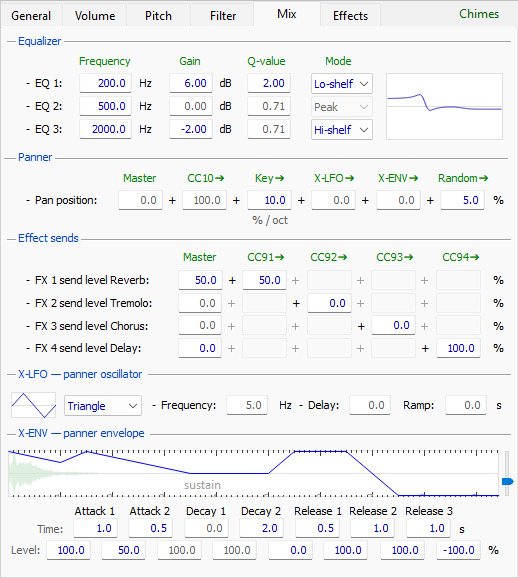
Mix articulation tab, with EQ, panner and sends
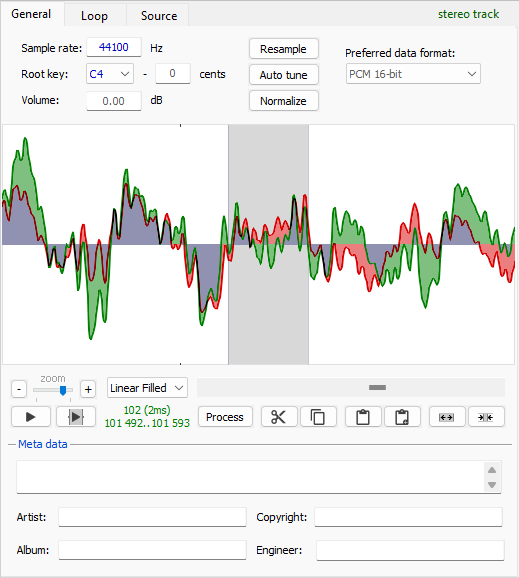
Waveform general tab, with the waveform editor
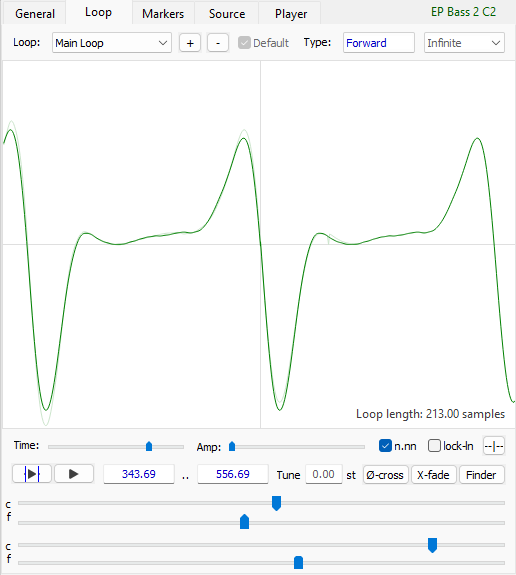
Waveform loop tab, with the loop point editor

Audio recording - step 1 - Setup and config

Audio recording - step 2 - Recording and post-processing
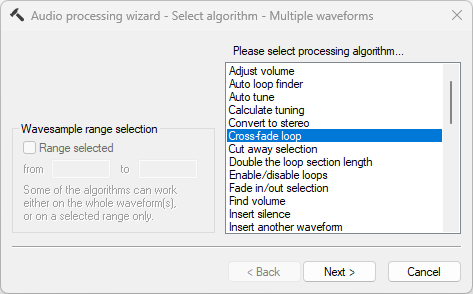
Audio processing - step 1
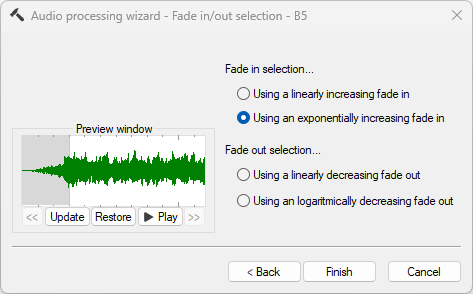
Audio processing - step 2 (example)
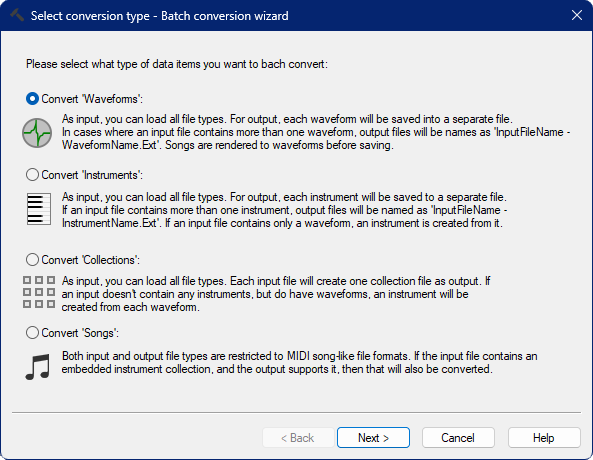
Batch Conversion tool - Step 1: Select batch type
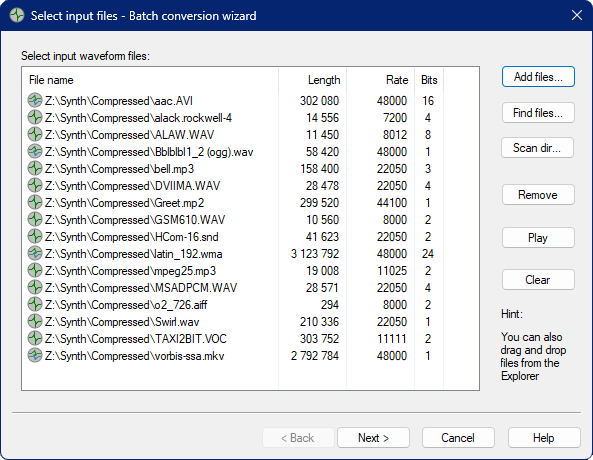
Batch Conversion tool - Step 2: Select input files
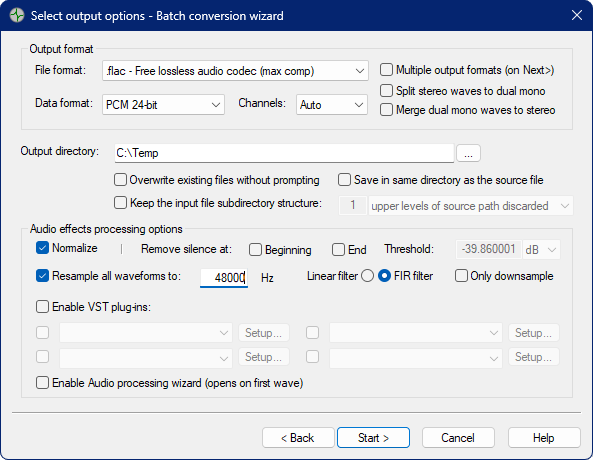
Batch Conversion tool - Step 3: Select output options
Awave Studio is commercial software marketed as Shareware.
This means that you get to "try it before you buy it".
If you find that you like it, and wish to continue using it past the 30 day free trial period, then you need to buy a license.
Note that this software is supported for Windows only
(for other platforms, you can try Wine, but be sure to test it before buying).
Buying it will:
- Remove the "nag screen" and annoying reminders.
- Remove the "restart after each save" limitation.
- Enable locked features — e.g. saving collections and batch conversions.
Buy it on-line here:
All payments are handled by PayPal.
Most credit cards are accepted.
You do not need a PayPal account.
EU-customers: VAT will be added to the price.
When you buy it, you will be sent a personal license key by email.
Note that this is
NOT sent out immediately —
We normally process your order within 24 hours.
License and delivery:
What happens next?
After we have received your order, we will send you an email with a personal license key file that unlocks the trial version into the full version.
If you have not received your code after 24 hours, first do check your "spam" or "junk" folders before contacting us.
How may I use it?
What you buy is a single user license.
You are allowed to install it on more than one computer, but you are not allowed to let other persons use it.
The license is personal and issued in your name. It cannot be transferred or resold.
What is your upgrade policy?
We have a policy of a minimum of two years of free upgrades, meaning that any new major version that may be released within two years from the purchase date will be a free upgrade. After that period, there may be an upgrade fee for a major update.
Minor version updates are always free if you own the same major version, regardless of the time that has passed.